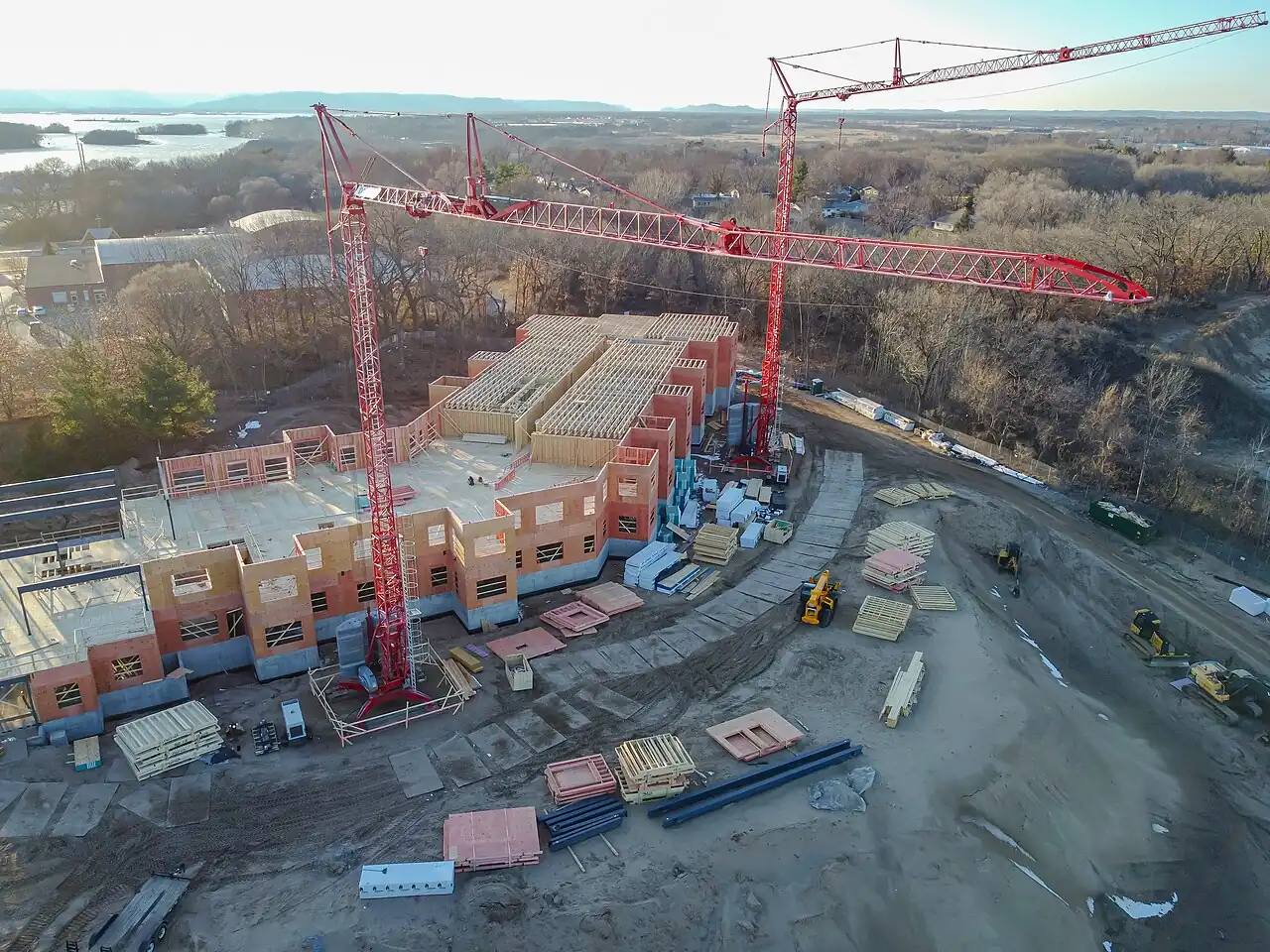
Tower Crane Rental in Eagle Pass
For multi-story and congested sites where a crane needs to stay for months—planning, foundation, erection and dismantle.
Tower cranes make sense in Eagle Pass for multi-story buildings and tight sites where a crane must stay for months—hospitals, schools, hotels and mid-rise commercial projects.
When to use a tower crane
Tower cranes are fixed to a foundation (or a building core) and stay on site for the length of the structure. They're the standard for:
- Multi-story buildings: hotels, hospitals, schools, apartments and offices.
- Tight sites where a mobile crane has no room to set up.
- Projects with frequent lifts every day for months.
Main tower crane types
- Hammerhead (flat-top): horizontal jib with a trolley—most common on commercial buildings.
- Luffing jib: the jib raises and lowers, useful when the crane can't swing over neighboring properties.
- Self-erecting: smaller tower cranes that unfold from a trailer—handy for low-rise and residential projects.
What a tower crane project involves
- Choosing jib length and capacity at the farthest pick point.
- An engineered foundation designed for the crane and your soil.
- Erection with a mobile crane, then climbing (adding sections) as the building rises.
- FAA notice if required, inspections and qualified operators.
- Dismantle at the end of the job—plan access for the mobile crane that takes it down.
Typical uses in Eagle Pass
- Multi-story buildings
- Hotels & hospitals
- Schools
- Tight urban sites
Permits & lift-planning basics
- Qualified people: Federal OSHA rules for construction cranes (29 CFR 1926 Subpart CC) require certified or qualified operators, qualified riggers and signal persons, and adequate ground conditions. Ask the operator for current certifications and a certificate of insurance before work starts.
- Power lines: OSHA generally requires keeping cranes at least 20 feet from power lines up to 350 kV unless the utility de-energizes the line or a specific clearance plan is in place. Call the utility early if lines are close.
- Ground and outriggers: Outrigger loads can be very high. Know where underground tanks, vaults, septic systems and utilities are; operators use crane mats or pads to spread the load.
- Moving the crane: Large cranes and their counterweights often travel under Texas oversize/overweight permits (TxDMV), which affects routing and timing.
- Streets and right-of-way: Setting up on a public street or sidewalk usually needs a permit or approval from the city or county—check with Eagle Pass or Maverick County before the lift date.
- Airspace: Cranes taller than 200 feet, or near a public-use airport such as Maverick County Memorial International Airport (5T9), may need an FAA Form 7460-1 notice filed at least 45 days before the crane goes up.
- Critical lifts: Many contractors require a written lift plan for picks above roughly 75% of chart capacity, tandem lifts, lifts over occupied areas or personnel lifts.
Request a free quote
Tell us about your lift anywhere in Eagle Pass & Maverick County. We'll connect you with a vetted local crane operator who will send a written quote.
- Free, no-obligation quotes
- Operated rentals—hourly, daily or monthly
- Hablamos español